

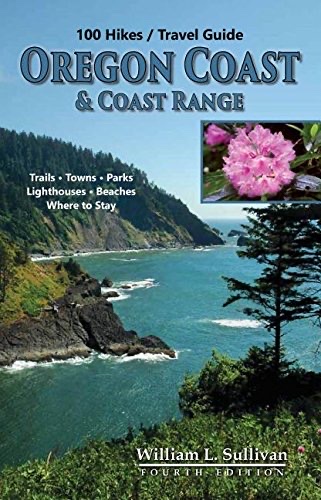
Lace up your walking shoes, pack a lunch and head to the Oregon coast for some of the best day hikes in America. And if you are a regular walker around the state, you will not be caught without your William L. Sullivan guidebook.
Sullivan, who once backpacked solo for 1,361 miles in his beloved state, has written 18 books about Oregon, which is similar in size to Great Britain and, like Britain, is known for valuing public pathways. His book about the Oregon coast is one of five regional offerings that feature 100-plus day hikes each. He also chose his 100 favorites for a book covering the entire state.
Hand-drawn maps, difficulty ratings and user-friendly narratives have guided Sue and me on countless walks around Oregon since we moved to Ashland in 2014.
One of our most memorable outings, described in the Oregon Coast and Coast Range guide, is actually more of a drive than a walk. After 12 miles of a twisting, rough gravel road that begins near the southern city of Brookings, Sullivan’s book guides walkers to a 1.6-mile trail, round trip. This one is all about the destination, a Japanese bombing site. On September 9, 1942, a small plane was assembled on the deck of a Japanese submarine off the coast of southern Oregon. After the wings were attached, a pair of incendiary bombs were loaded. A catapult launch sent the plane inland for its mission: Start a forest fire to undermine America’s war effort. Sullivan tells the story and leads hikers to the bombing site. It is a beautiful, forested walk to an observation deck where signs chronicle pilot Nobuo Fujita’s daring attack.
Besides many rewarding walks on the coast, Sullivan’s Northwest Oregon guide has led us on spectacular adventures near Bend, a mecca for outdoor enthusiasts. We are also partial to his guide about southern Oregon, our home.
When we depart on a trip to explore Oregon, we never leave home without Sullivan’s invaluable guidance.

 Books and my backpack