
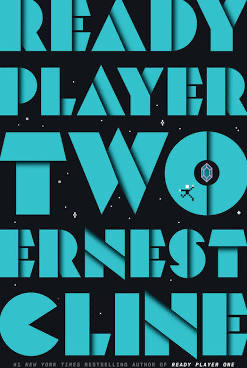
Imagine an alternate reality where people can do more than see, hear, and control a “game.” Instead, the events are real and the library is massive. And in the new world, people are actually reliving (that means all the senses) a person’s experience, feeling everything that person felt. Adults can choose something they would like to do and in whose body they would like to do it. For up to 12 hours a day. Yep, even sex.
Do you see problems with this alternate world? Ethics? Addiction? Confusion? Privacy? A devaluation of “real” life? An end of the world as we know it?
Those were some of my questions as I read the first part of Ready Player Two, Ernest Cline’s sequel to the hugely successful Ready Player One. I expected Cline’s story to explore more about these dilemmas within an adventure story comparable to the action of his first book. But, most of the time, I was left considering my questions on my own.
There was plenty of action. Maybe too much, too fast. Fans of John Hughes’ movies, Prince’s music and life, even the Lord of the Rings, may love the rapid-fire references.
The book is full of riddles, avatars, time travel, teleporting, dark events, “needle drops,” and more. It kept my attention most of the way. But, unlike how I felt while I read the first book, I was not on the edge of my seat.

 Books and my backpack