

Words Become Lessons for Boy, Teen, and a Man

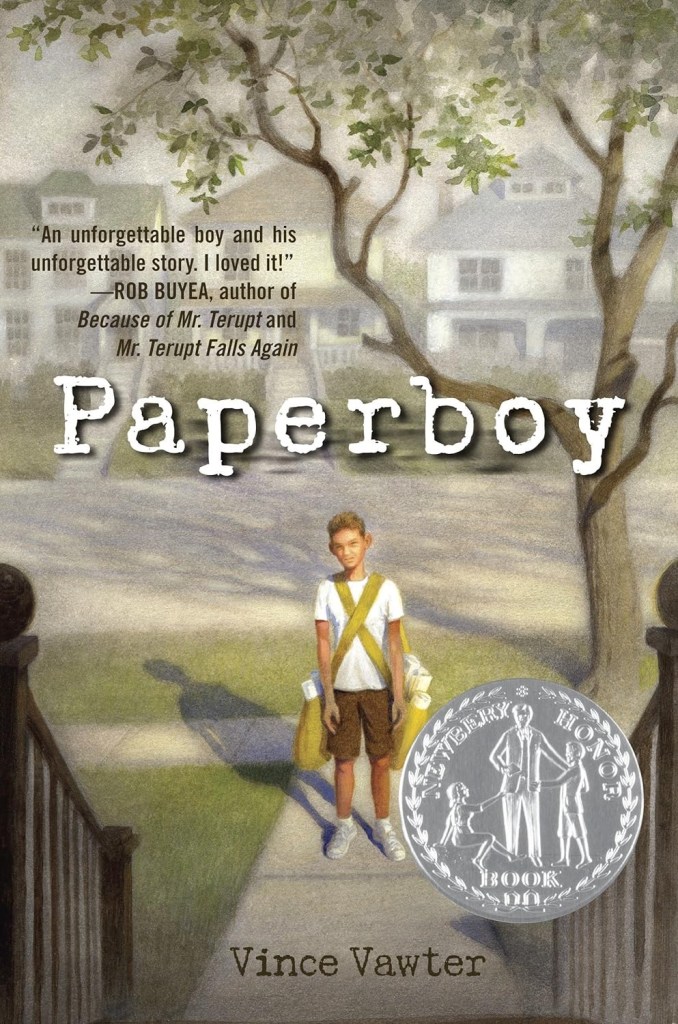
Vince Vawter’s trilogy begins with Paperboy. Look at the cover; see the medal marking it as a Newbery Honor Book? For me, this makes it a must read since the award is one of the most reliable predictors of books I will love. Paperboy is brilliant and I quickly zipped through the book as well as Copyboy and Manboy, sequels that continue Vawter’s riveting autobiographical story.

Known as Little Man in the first book, the engaging 11-year-old describes his battle with stuttering while he embarks on a lifelong newspaper career. His newspaper work begins as a paperboy while his friend Art (who he calls Rat because it is easier for him to say) is away. Little Man is troubled by one of his customers who has a drinking problem, which may be related to her abusive husband. He is raised by a black housekeeper (Mam), whose words of wisdom guide him to strengthen his confidence. He gives rapt attention to stories from Mr. Spiro, a customer on his route whose words cause the boy to explore concepts and thoughts that challenge his core.

As a 17-year-old in Copyboy, Vic takes a break from his part-time job as a newsroom assistant to travel to New Orleans to carry out the last wishes of his beloved friend, Mr. Spiro. There he continues to learn life lessons from others’ words, this time a quirky girl, Philomere (Phil), who saves his life during 1965’s Hurricane Betsy. After barely surviving the elements in an effort to fulfill Mr. Spiro’s dying request, he returns to Memphis with his love for Phil and a question: What is my purpose?

The tables turn in Manboy, which picks up after his parents have divorced. Vic is 21, a college frat boy and still working at the newspaper, when Phil comes to Memphis to visit and to reveal a secret that will change his life plans. It is April 1968 and his weekend with Phil is turned upside down by the assassination of Martin Luther King Jr. Vic’s stuttering, though somewhat relieved, still challenges him as he pivots from learning lessons from others to listening to his inner voice for wisdom.

The books take place in Jim Crow Memphis and New Orleans as Little Man grows into Sporty Boy, and finally into Vic. He becomes more aware of racial tension and inequities. The story is an honest and moving portrayal of love, of life in the South, and of a boy’s battle against being defined by his speech disorder.

Once again, the Newbery award has guided me to literary works that will stay with me for a long time.

Brushes With Fame Come to Life at St. Louis’ Blueberry Hill

Stars on the Walk of Fame line the sidewalk at the Blueberry Hill nightclub, which has been visited by a plethora of musicians and other celebrities. Chuck Berry performed here for many years. Four U.S. presidents dropped by.


I pointed to the star imbedded in the sidewalk along Delmar Boulevard, home to the St. Louis, Missouri Walk of Fame.

“I know that guy.”

Sue and I had stopped for a visit on our way to visit our son in West Virginia. She had heard the story about how I knew the guy, so I kept my reminiscing to myself.

It was the summer of 1970. I was 18, loving another visit to Dodger Stadium in Los Angeles. I yearned to witness more memorable events that had marked my three years as a sports journalist while I attended high school.

Bill Clark, my Oxnard Press-Courier newspaper colleague, sat next to me in the Dodger Stadium press box. In the row in front of us, Herald-Examiner baseball writer Bob Hunter, a former colleague of Bill’s, took his usual place at Dodger home games. After the game, Bill drove us to Hunter’s bar near the stadium. My 21st birthday was a lifetime away, so I waited in Bill’s white Chrysler Imperial while Bill went inside for “a drink.”

An hour ticked by. A knock on the car window jolted me awake. Bill peered in.

“Bob said you can come in.”

In a world of grownups, I sat at the bar next to Bill. I sipped a Coke, wishing it was spiked with a couple shots of rum. I downed several Coke refills while Bill drank a few more of his drinks. We talked baseball with Bob as he worked behind the bar. At first, I hardly noticed the middle-aged guy who pulled himself onto the barstool to my right. The auburn-haired man and I exchanged friendly words; I shared that I had just seen the Cardinals beat my Dodgers. He asked me all about how I got into sports journalism.

It was well after midnight when Bill and I walked toward his car.

“Here.” He handed me his keys. “You’d better drive.”

The V-8 engine roared to life. I pushed the “D” button next to the steering wheel and the car lurched forward a bit faster than I intended. Bill didn’t seem to notice. He said he was not looking forward to his sports desk shift that would begin at 6 a.m.

“Now, Reg, you know who was sitting next to you in the bar, don’t you?”

“Nah. Kinda dark in there.”

Bill shook his head. “Jeez! That was Red Schoendienst! You do know who that is, I hope.”

I had to think quick. “Just kidding.” I chuckled. “Of course I knew who he was.”

As I steered the huge car toward the freeway, I wondered if I had disguised the fact that I had not recognized the man who would be inducted into the baseball Hall of Fame. He wore a major league uniform for 74 years as a player, coach, or manager. On the night we chatted, he was the winning manager.

I was the kid without a clue.