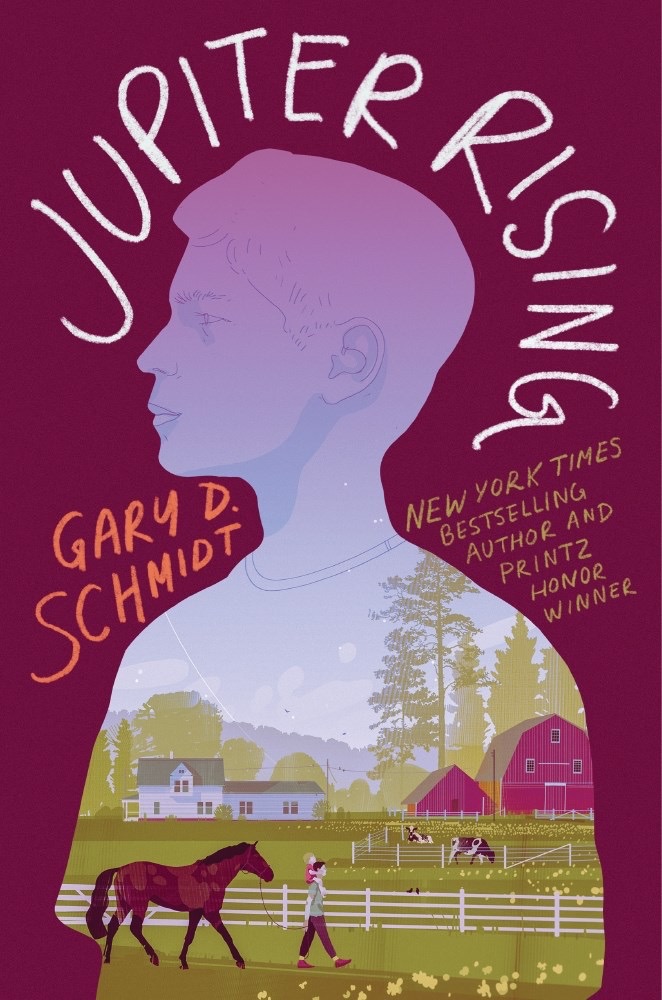
Another Winner From Gary D. Schmidt

Don’t judge a book by its cover.

This metaphorical phrase is a powerful theme of Jupiter Rising, by Gary D. Schmidt, author of two Newbery Honor books.

As the book launches, high school student Jack is mourning the loss of his step brother Joseph in a tragic event. Joseph, a teen father, leaves behind his orphaned daughter, Jupiter, who lives with Jack and his parents. In a move that makes no one happy, Jack’s P.E. coach assigns Jack to run with fellow student Jay to prepare for the school cross-country team.

At the beginning, I was tempted to label one character as an insensitive bully, another as pushy, a third as an irresponsible loser. At least Jupiter had Jack and Jack’s parents to look after her after her father’s death.

Like Jack, I learned that several of the people in his life are not who he thinks they are. And another gut-wrenching loss looms. No one will be left unaffected in a staggering series of events.

Jupiter Rising is one more compelling story by my favorite author of books for children, young adults, and everyone else. Schmidt creates characters who carry baggage and qualities that he unveils in tantalizing sequences. It is a sequel to Orbiting Jupiter, but can stand on its own.

If you are looking for another superb Schmidt book, try Okay for Now, which redefined excellence in youth literature for me.

Gary Paulsen: Gone, But His Voice Lives

It was “like peeling an onion.”

Gary Paulsen used those words to describe how he felt while writing his memoir, Gone to the Woods: Surviving a Lost Childhood.

Author of more than 200 books, mostly aimed at children aged 10 and up, Paulsen wrote the gut-wrenching childhood story that was published shortly before he died of cardiac arrest in October 2021.

Gone.

To live, in 1944, at just five years old, with relatives on their Minnesota farm to escape his alcoholic mother who had made him sing in Chicago bars.

Gone.

At age seven, to the Philippines, where he witnessed grisly living conditions and killings that would haunt any adult, while living with his parents. Both of them alcoholics. His father served there during World War II.

Gone.

Would describe a teenager who looked for ways to escape his life with his parents back in the USA. Gone to the woods, where he learned to hunt and trap his own food. Gone to the library, where he learned to love books thanks to a librarian whom he at first suspected might be like other kids and adults in his life: Up to no good. But that librarian came to know him without many words passing between them. Her gift of a spiral notebook and a yellow Number Two pencil changed his life.

In his memoir, Paulsen talks about himself in the third person. Is it to keep emotional distance from himself (“I”) and ”the boy,” which he uses throughout the book?

Gone.

But a voice I still hear. His most famous work, Hatchet, about Brian, a youth who survives by himself in the Alaskan wilderness after a plane crash, was one of my favorites to read aloud in class to my sixth-graders and to my sons as they sat next to me on the couch where we shared other Paulsen books. The book moved me, enthralled me. Newbery Medal judges chose it as a most cherished book, one of three Newbery honors he won.

As an adult, Paulsen lived a life filled with his awe for nature. He sailed, hiked, explored, even entered the Iditarod three times, completing it once.

Through his characters and stories, Paulsen taught millions of kids (and more than a few adults) life lessons. In Hatchet, Brian remembers that the tears he shed during the hard times he endured had taught him “the most important rule for survival, which was that feeling sorry for yourself didn’t work.”

Not gone.

Gary Paulsen’s characters, lessons, and the growing 35 million copies of his beloved books will be around for a long, long time.