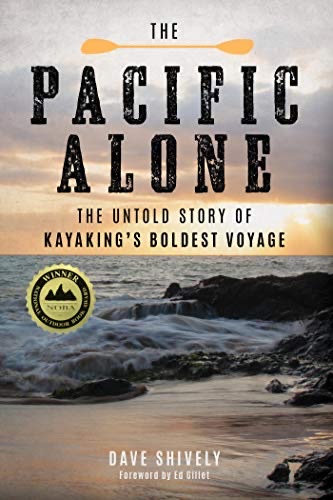
In 1987, Ed Gillet accomplished something no one had ever done. Despite many efforts, no kayaker has duplicated his fete, or even come close.
Gillet, who was in his 30s, kayaked from Monterey, California to Maui. He reached Hawaii after 64 days and returned to California the next week to appear on the Tonight Show with Johnny Carson. (The interview is on YouTube.)
Gillet had otherwise sought no publicity; he was frustrated that he had been portrayed in the media as a crazy guy who was lucky to make it to Hawaii.
He became a high school English teacher in San Diego and did not talk publicly about his voyage for 25 years. When Gillet was 64, journalist Dave Shively, a knowledgeable kayaker, convinced him to tell his story and share his journal. Shively’s account became The Pacific Alone: The Untold Story of Kayaking’s Boldest Voyage. It is a gripping, superbly written book about a man who pushed the limits of human endurance, survival and perseverance.
Gillet described his journey as an attempt “to gain the perspective that is hidden from those who stay close to shore.” I was only reading a book, but at times I could smell the ocean, taste the raw mahi mahi, see the stormy seas, hear the silence of being at sea, and feel my body breaking down.
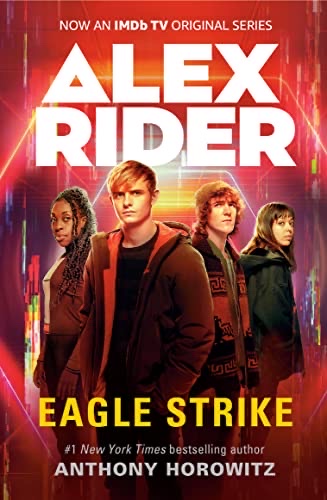
The fourth (left) and first books were adapted for TV. Click on the covers to find them on Amazon (USA).
Alex Rider, 14, has been raised most of his life by his uncle Ian after his parents died. He goes to school, but otherwise lives an extraordinary life as his uncle takes him on “business” trips while helping the boy become an expert in self defense, surfing, skiing, bicycling and more.
One day Alex is told that his uncle has died in a car crash because he was not wearing a seat belt. “Not possible,” Alex thinks. “He always wore his seat belt.”
His suspicions lead him on a mission to find out what really happened to his uncle and he discovers that the man he loved like a father was an agent for British secret intelligence and was murdered in the line of duty. What Alex does not know at first is that he is being watched closely, by the people who killed his uncle and by Alan Blunt, the head of special operations for MI6. And Alex eventually realizes his uncle has made sure the boy learned special skills because his uncle suspected they would save his life many times.
British author Anthony Horowitz is riding a wave of success with the Alex Rider books and their adaptation to a popular television program that is almost certainly going to be renewed for its third season. The 12-book series was written with the teen-aged audience in mind, but I think Horowitz knew it would also appeal to adults who can’t resist spy thrillers.
In each of the four books I have read, Alex reminds me of a young 007, keeping me on the edge of my seat as he faces near impossible odds of survival. Just as in the James Bond films, I am enthralled by his narrow escapes just as I chuckle at the ridiculous ways he eludes and defeats his enemies. Instead of a specially equipped sports car, Alex rides a uniquely powered bike in Eagle Strike. Of course, there is an MI6 operative who provides Alex with special “toys.” Like 007, the magic is not whether Alex will win in the end, but how he will defeat evil. (By the way, Horowitz has also written three James Bond novels.)
Alex’s MI6 handler, Mrs. Jones, and his guardian Jack, think Alex should live the life of an ordinary teen-ager. But Blunt needs Alex to handle special assignments tailored for a kid. And Alex has inherited a compulsion to save the world. Yes, there is a girl involved in his life. And a best friend–Tom–who plays a major role from the beginning in the TV series, but later in the books.
Alex is 16 years old in the Amazon Prime and Amazon IMDb series, which recently posted its second season, adapted from the fourth book, Eagle Strike. Book two, Point Blank, was adapted for season one. The first book, Stormbreaker, was made into a 2006 motion picture, also available on Amazon TV. I highly recommend the TV series, but the movie is marginal despite its all-star cast.
I have to go now. It is time to download the fifth book, Scorpia.