
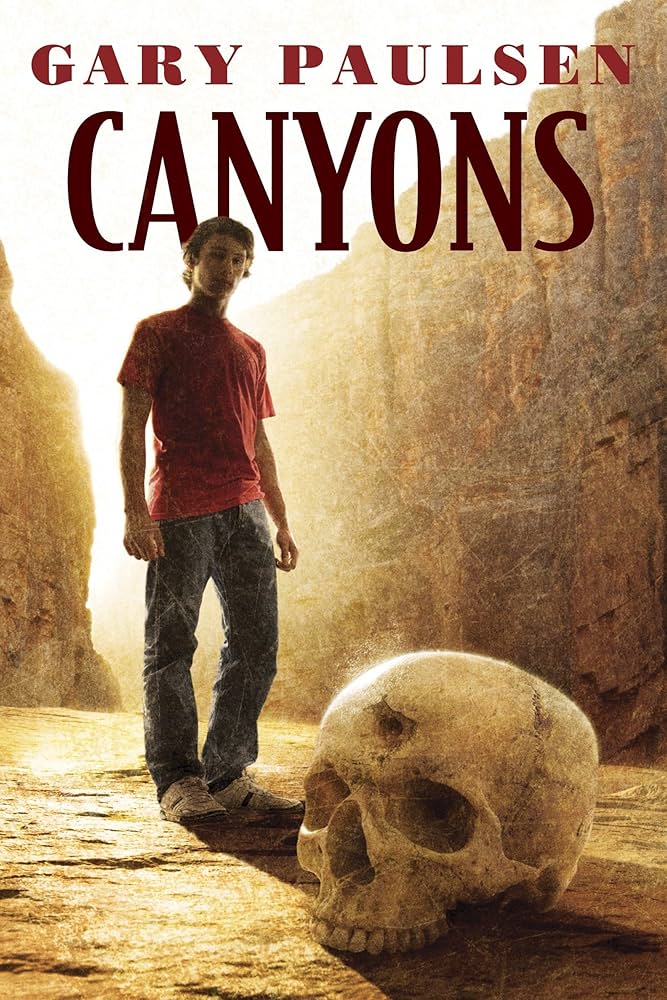
Gary Paulsen Pens a Masterpiece Adventure

There has been no better storyteller than the late Gary Paulsen, author of 200 books and best known for the adventure survival masterpiece Hatchet, the basis of a motion picture set in the Alaskan wilderness.

Canyons may be his best book, though. It is a story of two youths’ paths to manhood, separated by more than a hundred years, but bound by an extraordinary commitment to find closure.

Coyote Runs is a 14-year-old Apache warrior; Brennan Cole, 15, lives in New Mexico, near the canyons that Coyote Runs knows well. In 1864, during a horse raid across the Mexican border to prove his manhood, Coyote Runs is chased for days back to New Mexico, finally wounded in his leg by a rifle shot that kills his horse. He drags himself up a sandy slope and hides under a rock outcropping, depending on his spirit protector. But a bloody trail leads the Cavalry to the boy, who watches the end a rifle barrel find his forehead.

A century later, Brennan, his mom, her boyfriend, and eight pesky eight-year-old boys are camping in a New Mexico canyon. Seeking quiet and privacy, Brennan pulls his sleeping bag up a sandy slope and unfurls it under a rock outcropping. He crawls into his bag, so ready for rest.

”What’s that?” he thinks. He sits up, digs under the sand and finds a round rock—no, it is a skull. There is a hole in the skull just above the eyes and a much bigger void in the back.

Thus begins Brennan’s quest and he will not–no matter the roadblocks and consequences–quit until he discovers who died in that canyon and brings closure to the boy’s spirit, whose words guide him.

This week, I returned to Canyons, which I had read to my sons and to hundreds of students. It didn’t matter that I knew the spellbinding conclusion. Like all those times, my heart hung on Gary Paulsen’s every word.
Come Aboard Dove for an Unforgettable Voyage

I begin with advice for parents: Don’t give Dove to your kid if you want him or her to live a life in one place, or even in one country.

And definitely hide the book unless you want to encourage youthful thoughts about adventures that pose life-threatening risks.
The kid in the book is now 75 and lives in Montana, but I wonder if he would have supported such an undertaking for either of his children.
Robin Lee Graham was 16–yes, just 16–when he sailed from California, westward in 1965, destined to become the youngest to sail around the world alone.

Many at the time questioned his father’s wisdom. What was he thinking? How could he let him go? I would ask those naysayers: What if his dad had tried to stop him?

His mother tried everything to block his trip, but his dad had sailed with Robin extensively and knew the journey may have been a huge risk for even the most experienced sailor, but he refused to squelch his son’s spirit for adventure and solitude.

Five years later, Robin returned a married man (still sailing solo, though), about to become a father, and was a global celebrity built by three major stories and photo spreads in National Geographic magazine. There were also countless stories about his journey by media outlets worldwide. Courage beyond belief, luck, emotion, dreams, naiveté, extreme loneliness, depression, and two (sometimes three) cats were his companions. Based on the numerous close calls Robin survived, maybe he was the one with nine lives.

If you follow my book reviews, you know I am a sucker for adventure stories. I love following people, young and old, who reject the comfort of their couches in favor of the hardships, uncertainty, and joys of traveling long distances on their feet, boat, bicycle, or other conveyance.

Dove is a great book. Robin wrote it along with Derek Gill, first publishing in 1972. It is based on the recordings he taped and sent home during his many stops along the way.

I will resist the temptation to tell you more. If you read Dove, you will be glad I stopped here.