Thru-hiking’s Other Triple Crown

The year 2021 brought new focus to thru-hiking’s Triple Crown. Sammy Potter and Jackson Parell, a pair of Stanford college students, walked more than 7,000 miles on the Appalachian Trail, the Continental Divide Trail, and the Pacific Crest Trail in spectacular fashion–within a calendar year.

And three women, the Wander Women, all retirees in their 60s, completed the Pacific Crest Trail, achieving their Triple Crown, one thru-hike a year for three years.

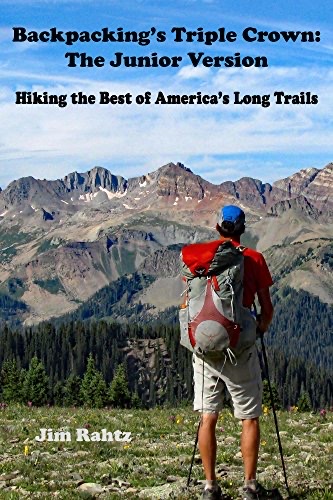
Jim Rahtz’s book presents three thru-hikes for those who don’t have the many months or inclination to walk so far: Backpacking’s Triple Crown: The Junior Version.

Don’t let the “junior” in the title fool you into thinking these are casual adventures. Each is a section of the longer trails, and Rahtz argues they cover perhaps the most beautiful sections.

The John Muir Trail runs 220 miles from Happy Isle in Yosemite National Park to the summit of Mount Whitney. Many PCT walkers say it is their favorite part of the longer trail and maybe even the most difficult.

The Colorado Trail begins near Denver and ends near Durango. At 486 miles, it is the longest “junior” trail, nearly duplicating the length of Spain’s Camino de Santiago.

The Long Trail is 273 miles and winds the length of Vermont. The first 100 miles or so is also the Appalachian Trail.

Rahtz has walked all three and his stories make it clear these shorter versions are more approachable, but not to be taken lightly.

Which of the three is hardest? Most beautiful? Easiest?

Sue and I walked the John Muir Trail (with mules packing most of our stuff) in August 2021 and can’t imagine that any mountain trek could be more beautiful. But we yearn for further adventures. While Rahtz’ book makes it clear the other two could be even more difficult than the JMT, it tempts me to add a Triple Crown to our other trekking accomplishments. Are we up for the challenges? Could we carry everything we need?

Gary Paulsen: Gone, But His Voice Lives

It was “like peeling an onion.”

Gary Paulsen used those words to describe how he felt while writing his memoir, Gone to the Woods: Surviving a Lost Childhood.

Author of more than 200 books, mostly aimed at children aged 10 and up, Paulsen wrote the gut-wrenching childhood story that was published shortly before he died of cardiac arrest in October 2021.

Gone.

To live, in 1944, at just five years old, with relatives on their Minnesota farm to escape his alcoholic mother who had made him sing in Chicago bars.

Gone.

At age seven, to the Philippines, where he witnessed grisly living conditions and killings that would haunt any adult, while living with his parents. Both of them alcoholics. His father served there during World War II.

Gone.

Would describe a teenager who looked for ways to escape his life with his parents back in the USA. Gone to the woods, where he learned to hunt and trap his own food. Gone to the library, where he learned to love books thanks to a librarian whom he at first suspected might be like other kids and adults in his life: Up to no good. But that librarian came to know him without many words passing between them. Her gift of a spiral notebook and a yellow Number Two pencil changed his life.

In his memoir, Paulsen talks about himself in the third person. Is it to keep emotional distance from himself (“I”) and ”the boy,” which he uses throughout the book?

Gone.

But a voice I still hear. His most famous work, Hatchet, about Brian, a youth who survives by himself in the Alaskan wilderness after a plane crash, was one of my favorites to read aloud in class to my sixth-graders and to my sons as they sat next to me on the couch where we shared other Paulsen books. The book moved me, enthralled me. Newbery Medal judges chose it as a most cherished book, one of three Newbery honors he won.

As an adult, Paulsen lived a life filled with his awe for nature. He sailed, hiked, explored, even entered the Iditarod three times, completing it once.

Through his characters and stories, Paulsen taught millions of kids (and more than a few adults) life lessons. In Hatchet, Brian remembers that the tears he shed during the hard times he endured had taught him “the most important rule for survival, which was that feeling sorry for yourself didn’t work.”

Not gone.

Gary Paulsen’s characters, lessons, and the growing 35 million copies of his beloved books will be around for a long, long time.